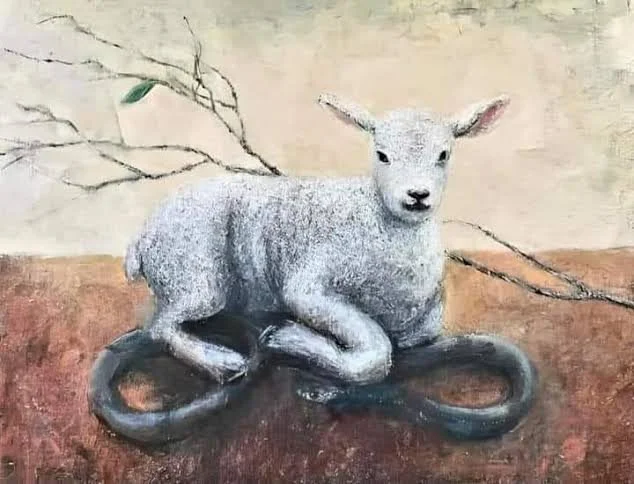
Fire vs. Clay: Why Your Vulnerability Is Divine Architecture
Is vulnerability a flaw under the law, or the exact vessel designed to hold the Breath of God? Explore the biological, scriptural, and thermodynamic proof that divine love and soft clay will always outlast cold, armored force.
The Snake and the Clay Lamb
Once upon a time, on the dusty banks of a wide river, lived a cold-scaled Snake and a soft-fleshed Lamb.
The Snake was proud of his independent setup. His body was wrapped in hard armor, his eyes were covered by clear protective scales so he never had to blink, and his tongue flicked through the air to smell the world. Because he had no ears, the Snake lived in total, silent isolation—he couldn't hear the song of the birds, the rush of the wind, or the voices of other creatures. He only cared about the heat signatures of prey and the vibrations of the dirt beneath his belly.
"Look at you," the Snake hissed silently toward the Lamb, sizing her up with his heat-sensing facial pits. "You are soft. You have no scales, no claws, and no armor. Your skin bleeds if you scrape a thorn. You have to stay close to your flock just to keep warm, and you cry out to one another constantly because you are weak!"
The little Lamb looked at her soft wool, her thin skin, and her wet nose. She shivered in the cold river wind. "Maybe I am weak," the Lamb thought. "I don't have armor, and I get lonely."
One day, a sudden storm rolled over the valley. The river overflowed its banks, and the sun vanished behind thick, freezing clouds.
Because the Snake was cold-blooded, the dropping temperature froze his engine. Without external heat, his muscles stiffened until he couldn't even coil his body to crawl up the bank. He lay frozen in the mud, trapped inside his own rigid skin. Because he was deaf, he couldn't hear the roaring floodwaters rising right behind him.
The Lamb saw the Snake freezing in the mud. Even though her skin was thin and her flesh was soft, her warm mammalian blood kept her moving. She didn't have scales, but she had a heart that felt empathy—and ears that heard the danger.
She called out to her flock. The lambs huddled close together, combining their shared body warmth to push through the freezing rain. Together, they gently rolled a floating log beside the Snake and nudged his stiff, frozen body onto dry ground away from the flood.
As the sun slowly returned and thawed the Snake's blood, he felt the warm vibrations of the flock standing together around him. For the first time in his long, silent life, the deaf Snake realized a quiet truth:
His hard scales and silent solitude were built for basic survival, but they left him isolated, deaf to the world, and frozen in the storm. The Lamb’s soft skin, hearing ears, and deep need for connection weren't a defect at all—they were the exact design that brought warmth, rescue, and life.
The fable of the Lamb and the Snake isn't just an ancient story—it is hardcoded directly into our biology, our sacred scriptures, and the fundamental mechanics of creation.
2. The Built-In Miracle: The Self-Healing Clay
There is an astonishing biological truth about human clay that we often overlook: when we get a scrape on our knee, it heals all on its own.
A snake's hard, rigid scale cannot regenerate or heal from within if it is shattered; it can only shed its entire outer skin in a stressful, blind process. But soft human clay is packed with living blood vessels, immune cells, and growth factors.
When your soft skin gets bruised or cut, your body immediately triggers a cascade of living signals: blood clots, white blood cells clean the wound, and new cells knit the flesh back together. You don't have to consciously direct it or earn it—your soft, vulnerable body was hardcoded with a built-in capacity for regeneration and renewal.
Our capacity to be bruised is the exact same feature that allows us to self-heal. Vulnerability isn't a sentence to stay broken; it is the prerequisite for biological and spiritual restoration.
3. The Sacred Covenant: Fire, Clay, and the Cosmic Trial
The Desert and the Bronze Snake (Torah / Old Testament)
To prove his point that human clay was a failure under the Law, the Snake watched as God rescued the Israelites out of Egypt.
God led the people into a dry, scorching desert, giving them daily bread and water from rocks. But the people became ungrateful, complaining about the journey. The Snake stepped up to God in the cosmic court: "Look at them! By the strict Law of cause and effect, their soft clay deserves to perish."
God did not argue with the Law. He allowed desert snakes to bite the ungrateful people. But God did not abandon the clay. He told Moses to build a Bronze Snake and lift it high on a pole (Numbers 21). "Whoever looks at the bronze serpent will live," God declared. God used the Snake's own symbol to show the people: when you focus only on earthly pain, you get bitten by the law; but when you look up toward God's mercy, the venom loses its power.
The Virgin Birth & The New Covenant Love Story
For centuries, the Snake thought he had the ultimate biological flex: her ZY lineage was the only one that could perform a virgin birth in isolation through parthenogenesis. She believed this proved her self-contained design was superior to mammalian XX/XY clay.
Then came the grandest moment in history.
God looked at a humble human girl named Mary (XX). Without a human father, by the power of the Holy Spirit, Mary gave birth to Jesus. God had taken the Snake’s prized achievement—the virgin birth—and translated it into soft human flesh.
Jesus was born completely human—XY, warm-blooded, soft-skinned, needing water, milk, and human touch. He came not to live by the cold rules of the Snake's legal system, but to fulfill the Law and offer unconditional Grace.
When Jesus was lifted up on a wooden cross—just like the Bronze Snake in the desert—He took the bitter "acid" of human failure into Himself and broke the legal contract forever. As Paul writes in Galatians 5:22-23, against the fruit of the Spirit—love, joy, peace, kindness—"there is no law." Divine love bypasses the adversary's legalistic calculations entirely.
When we look across sacred traditions, we discover that the trial between humanity and the adversary was established by divine agreement.
The Qur'anic Agreement: Fire vs. Sounding Clay
In the Qur'an, God reveals the elemental distinction that started the cosmic objection:
"And We did certainly create man out of clay from an altered black mud... And the jinn We created before from smokeless fire." — Surah Al-Hijr 15:26-27
When God commanded the angels and Iblis (Satan) to bow before the first human, Iblis refused based on material pride: "I am better than he. You created me from fire and created him from clay" (Surah Al-A'raf 7:12).
Instead of destroying Iblis on the spot, God granted his request for respite until the Day of Resurrection (Surah Al-Hijr 15:36-38). God allowed the cosmic trial to play out by strict rules: the adversary was given permission to whisper, test, and attempt to prove that human clay was weak—but was given zero authority over those who rely on divine grace (Surah Al-Hijr 15:42).
While this specific dialogue isn't recorded in the Old Testament, the exact same spiritual reality is echoed in the New Testament (Galatians 5:18, 22-23): “But if you are led by the Spirit, you are not under the law.” “But the fruit of the Spirit is love, joy, peace, forbearance, kindness, goodness, faithfulness, gentleness and self-control. Against such things there is no law.”
The Breath of God (Ruh)
Why did God honor human clay above independent fire?
"So when I have proportioned him and breathed into him of My [created] soul (Ruh), then fall down to him in prostration." — Surah Al-Hijr 15:29
Fire burns brightly on its own and consumes everything around it, but only hollow, soft clay can act as a vessel to hold the Breath of God. Our vulnerability is the empty space designed to contain divine Spirit.
4. The Native Language of Lies & The Roaring Lion (Dragon)
In the New Testament scriptures, Jesus strips away the theatrical bluff of the adversary during a tense legalistic confrontation:
"He was a murderer from the beginning, not holding to the truth, for there is no truth in him. When he lies, he speaks his native language, for he is a liar and the father of lies." — John 8:44
The adversary’s "native language" is projection and legalistic accusation. He projects the illusion of the grand, invincible dragon to keep human clay trapped in fear. But Apostle Peter gives us the sober prescription to disarm this theater:
"Humble yourselves, therefore, under God’s mighty hand, that he may lift you up in due time. Cast all your anxiety on him because he cares for you. Be alert and of sober mind. Your enemy the devil prowls around like a roaring lion looking for someone to devour." — 1 Peter 5:6-8
Notice that the adversary prowls like a roaring lion. The roar is an auditory flex designed to cause panic. But when we stay sober-minded—testing the real physical receipts of genetics and thermodynamics—we realize the roar is just noise meant to isolate us from God and community. (Read back to the Math never lies blog post - Richard Feynman breaks down what it means to be sober minded)
5. The Reality Behind the Dragon's Ego
King Arthur and the Round Table
Centuries later, in the kingdom of Camelot, King Arthur faced the same struggle.
Arthur’s kingdom was threatened by the illusion of flying fire-breathing dragons and rigid codes that punished every mistake. The knights wore heavy iron armor—trying to make themselves as hard as the Snake's scales. But Arthur pulled Excalibur from the stone because he had a soft, humble heart. He gathered his knights around a Round Table—a table with no head and no foot—forcing armored, proud men to sit face-to-face, drop their defensive walls, and practice connection and forgiveness.
Arthur realized what God had known all along: Armor can win a battle, but only soft hearts can build a kingdom.
Driven by insecurity over humanity's divine purpose, the Snake projected a grand, terrifying myth to rule creation through fear. But when you strip away the theatrical illusion, the Snake’s true physical reality maxes out at creatures like the Komodo dragon and the Boa constrictor:
The Ego: Claims to be an invincible, cosmic monster breathing fire and commanding total fear.
The Reality: A sluggish, ectothermic predator bound by temperature, constrained by thermodynamics, and forced to conserve every drop of moisture just to process its acidic waste.
By embellishing its own reality, the Snake tried to trick human clay into worshiping armor and isolation. But once you realize the "Dragon" is just a mythical projection created by a cold-blooded lizard in the mud, the fear vanishes completely—leaving only the victorious truth of God's grace.
6. The Genetics of Solitude vs. The Mechanics of Connection
If you look at the physical limits of creation, the biological differences in DNA highlight the contrasting purposes of both designs:
Biological Feature
The Serpent Blueprint (ZW)
The Human Blueprint (XY)
Genetic System
Female heterogametic (ZW), allowing facultative parthenogenesis (virgin birth in isolation).
Mammalian (XX/XY), requiring male and female union for life.
Sensory Apparatus
Physically deaf to airborne sounds (no external ears or eardrums); relies on jaw vibrations and thermal heat pits.
Hearing ears tuned to speech and vocal frequencies; complex social signaling.
Healing Mechanism
Rigid scales; sheds entire outer skin shell when damaged; no internal tissue regeneration of scales.
Self-healing living tissue; automatic cellular clotting and skin regeneration upon injury.
Thermodynamics
Ectothermic (cold-blooded). Bound by external heat; maxes out at Titanoboa and Komodo dragons.
Endothermic (warm-blooded). Consumes high energy to maintain steady internal warmth.
Neurological Wiring
Linear, utilitarian elimination pathways via a single cloacal vent; low social signaling.
Complex, overlapping pelvic nerve corridors; high oxytocin receptor expression for empathy.
7. Why Water and Softness Always Win
In a dry state, clay turns into brittle dust that crumbles under pressure. But when mixed with water—the ultimate universal solvent—clay becomes soft, moldable, and resilient.
Metabolic Acidity: Dehydration makes both our physical bodies and our spiritual lives acidic, rigid, and bitter.
The Living Water: Immersion, hydration, and symbolic rituals like baptism act as a biological and spiritual reset—flushing away the acidic, fear-based legalism of the adversary and restoring our soft human flesh.
When we stop trying to build rigid, armored shells around ourselves and accept our need for water, grace, and community, the adversary loses his legalistic grip. You cannot trap or intimidate someone who operates entirely in radical, unarmored love.
The Takeaway: A Heart of Empathy for the Whole Story
When we step back and look at the whole canvas, our bitterness toward the struggle vanishes—replaced by deep empathy for both God and the Snake.
We can finally understand the Snake. Built with incredible cold-blooded efficiency, hard scales, and the ancient ZW code to survive a harsh, frozen world, he looked at fragile, wet human clay and felt deeply cheated. In his desire for self-sufficiency, he couldn't comprehend why a Creator would favor something that bleeds, cries, and gets bruised. His roar, his legalistic rules, and his grand dragon persona were never proof of supreme power—they were the desperate bluffs of a solitary creature fighting to prove his own worth in a universe he felt left out of.
And we can finally understand the heart of God. God was never indifferent to the Snake’s frustration, nor was He reckless when He formed us from mud. Like a master potter, God knew that hard armor can protect a body, but only soft, hollow clay can be filled with His breath (Ruh). He allowed the cosmic trial to play out not to condemn us, but to prove that love, forgiveness, and mutual connection will always outlast cold, isolated force.
If you have ever felt fragile, exposed, or bruised by life, remember: your softness is not a defect—it is your divine architecture.
You don't need to build cold scales or become deaf to the world to survive. You were made as living clay—designed to scrape a knee, heal from within, drink the living water, and hold unconditional love. When we look at the Snake with understanding instead of terror, and look at God with trust instead of fear, the trial is complete. Softness held by grace wins every single time.
Dedicated to Denia 🫶
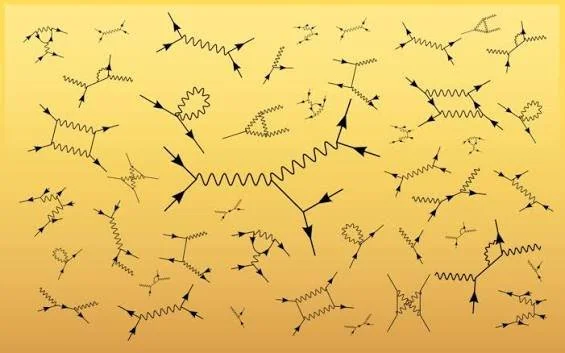
A Universal Truth: Math never lies.
The universe keeps its books with perfect math, and it never takes a bribe. From Feynman's C-clamp in ice water to a carpenter’s plumb line, explore why physical reality always beats clever paperwork, digital shortcuts, and public relations.
If you spend enough time around the old-timers in the trades you eventually hear a phrase that sticks in your ribs. The math never lies. It is usually muttered by an old carpenter squinting down a framing line or checking a layout. It is a short unvarnished way of saying that the universe does not care about your excuses. It only cares about reality.
Halfway across the country in the halls of top-tier universities and government hearings there was a physicist named Richard Feynman who lived by that exact same rule. Feynman referred to the Nobel Prize as a "pain in the a**" and considered it useless. He explained that by the time scientists win the prize, they are usually already established professors with grants. He disliked prestige, awards, and ego trips, believing that the true reward was simply the pleasure of discovery.

Richard Feynman at the Rogers
Commission Hearing, February 11, 1986
If you’ve never heard of Richard Feynman, he wasn’t your typical ivory-tower scientist. He was a Nobel Prize-winning physicist, but he spent his life acting more like a master mechanic of the universe. He hated pretension, he hated jargon, and he had a deep, lifelong respect for straightforward, practical reality. He would have appreciated the trades because, like a good builder, Feynman knew that the cosmos doesn’t care about your theories—it only cares about what actually works under pressure.
That’s why, in 1986, he was the guy called in to figure out why the Space Shuttle Challenger exploded.
He didn’t bring a massive slideshow or a stack of bureaucratic data to the hearing. Instead, he just sat at the press table, took a small piece of the shuttle's rubber O-ring, squeezed it in a little C-clamp, and dropped it into his glass of ice water. When he pulled it out and released the clamp, the rubber stayed pinched. It had lost its flexibility in the cold.
As architects, contractors, engineers, and tradespeople, we all ultimately answer to that exact rule.
An architect can draw a beautiful concept, an engineer can calculate the theoretical loads, and a draftsman can use digital software to make a flawed plan look perfect on a monitor. But the contractor is the one who actually has to shake hands with gravity. You can pass a rushed inspection or hide a mistake behind drywall, but you cannot charm thermodynamics, and you cannot negotiate with a foundation.
Newton’s Third Law isn’t a suggestion: for every action, there is an equal and opposite reaction. If a frame is out of square or a detail is cheated, the universe doesn't forget. Physical reality just bides its time and collects its tax later. The universe keeps its books with perfect math, and it never takes a bribe.
We’ve all seen the industry shift from the friction of the old world—where hand-drafting and physical layout forced us to respect the immediate limits of the material—to a hyper-fast digital world where shortcuts are easy to copy and paste. It's easy for the office and the field to get caught up in the speed of the rat race, chasing production goals, slashing margins, and pretending that if it works on a screen, it's good enough.
But like Feynman, a true builder knows that the paperwork is an illusion. The real test happens when the blueprint meets the dirt.
The plumb line doesn't care about our schedules, our profit margins, or our design software. It just points straight to the center of the earth, every single time, because reality wins in the end.
Next time we're looking at a detail that feels a little too clever, or pushing the limits just to keep the project moving, let's step back and ask ourselves: Are we honoring the actual math of the materials in our hands, or are we just hoping Nature won't notice the shortcut?
Scorpion Energy: Secular Grace in the Trades.
Observing your own nature without emotion means you don't have to strike just because your tail lifted. You are the master of the tool, not the victim of the reflex.
We don't need to change the scorpions we work with, and we don't need to change our own rugged edge. We just need to know how to handle the machine so nobody gets stung.
There’s an old fable about a scorpion that needs to cross a fast-moving river. He spots a frog on the bank and asks for a ride on his back.
The frog scoffs. "Are you out of your mind? You’re a scorpion. If I let you on my back, you’ll sting me and I’ll drown."
The scorpion argues back with pure logic: "Think about it. If I sting you out there in the deep water, you’ll sink, and since I can't swim, I’ll drown right along with you. It would be suicide."
The frog thinks it over. The logic is sound, so he agrees.
The scorpion climbs onto his back, and the frog launches into the river. They make it halfway across, fighting a heavy current, when suddenly the frog feels a sharp, searing pain in his back.
The scorpion just stung him.
As the frog’s legs go numb and they both begin to sink into the muddy river, the frog cries out in disbelief, "Why did you do that?! Now we’re both going to die!"
The scorpion just shrugs and replies, "I couldn't help it. It’s my nature."
If you’ve spent any time on a job site, in a workshop, or around old-school tradesmen, you’ve run into Scorpion Energy. It’s that hardwired, protective, sometimes razor-sharp nature. A lot of people see a grumpy mentor, a cynical coworker, or a guy who instantly snaps at outsiders, and they take it personally.
But anyone who understands pattern recognition knows better. You don't get mad at a hammer for being heavy, and you don't get mad at a scorpion for stinging. It’s just their nature… For men in the trades, pattern recognition is a survival mechanism. It tells us when a table saw sounds wrong, or when a load-bearing beam is about to fail. But when that same instinct turns inward toward human behavior, it can misfire…
It treats everyday friction like a threat to be struck down. True rebellion today—the new punk rock—isn't about screaming louder or thrashing against the world. It’s choosing radical self-possession and calm efficiency.
It’s about practicing a kind of secular grace: using gratitude not as a preachy, touchy-feely sermon, but as operational grease to keep the machinery of life from grinding itself to pieces. When we understand our scorpion nature, we can observe it without emotion instead of reacting to every indifferent stimulus.
Here are the three classic "Scorpion Archetypes" we all know, and the low-profile, high-efficiency tweaks that turn friction into peace:
1. The Hard-of-Hearing Veteran: Trading "Sorry" for "Thank You"
We all know the seasoned pro who has spent decades around loud machinery. Communication is already a battle, which naturally leads to crossed wires, missed cues, or scheduling friction. When things go sideways on a project, our baseline instinct is usually to apologize. We say, "Sorry that material is late," or "Sorry I didn't catch that the first time." But look at the mechanics of an apology: it highlights the failure and keeps the focus on the friction.
**The Scorpion Fix:** Instead of a defensive apology, you flip the script: "Thank you for being so patient!" or "Thank you for bearing with me."
By replacing an apology with a word of gratitude, you validate the other person's professionalism. You acknowledge the friction without making anyone feel defensive. It de-escalates the tension before it even starts.
2. The Lone Wolf: "Thank You, But No Thank You"
Then there’s the hyper-independent operator. This guy protects his peace with a razor-wire fence. He doesn't want small talk, and he definitely doesn't want unprompted advice or sales pitches from strangers. When an outsider breaches his perimeter, his gut reaction is an immediate, aggressive shutdown to protect his autonomy.
It’s efficient, but it leaves a wake of bad energy on the job site. He's burning his own fuel to sting someone who doesn't matter.
**The Scorpion Fix:** Implement a clean, unyielding boundary: "Thank you, but no thank you."
This is a velvet-wrapped concrete wall. It satisfies basic social courtesy just enough to strip away any excuse for confrontation, but it shuts the door so firmly that the outsider has zero room to push. The Lone Wolf keeps his absolute independence without wasting a single drop of venom.
3. The Stressed-Out Builder: The Power of Pause
The hardest type of scorpion energy to handle is the one born out of raw, outside-of-work pressure. When a guy is dealing with heavy personal loss, family crises, or bureaucratic red tape, his pattern recognition goes completely haywire. Because he's hurting, he feels backed into a corner and starts lashing out—trying to fight an indifferent system that cannot feel pain. He’s thrashing in the trap, fighting the timeline instead of tapping back into his stoic energy.
**The Scorpion Fix:** The Power of Pause.
Sometimes, the ultimate act of courtesy and leadership isn't trying to fix a guy’s problems or telling him to cheer up. It’s letting him sit with his messy feelings until he runs out of venom. In the trades, if a weld is bad or a piece of wood is warped, sometimes you just have to step away and let the material cool down.
For a guy in a high-pressure season, the path back to peace means looking at the tangible reality of today, finding the secular gratitude to say, "I have what I need for right now," and quietly going back to stacking cash and maintaining his baseline while the clock runs down.
The Takeaway
Observing your own nature without emotion means you don't have to strike just because your tail lifted. You are the master of the tool, not the victim of the reflex.
We don't need to change the scorpions we work with, and we don't need to change our own rugged edge. We just need to know how to handle the machine so nobody gets stung.
So, here’s to the scorpions we work alongside every day—the stubborn, the hyper-independent, and the fiercely loyal. They might be hard to read, and they definitely won't pass the vibe check at a corporate HR meeting, but they are the backbones of our shops and job sites. They teach us our craft, protect their crews, and show us what raw endurance looks like. We don't need them to change, and they don't need us to soften up. We just need to keep the gears greased, watch out for each other, and remember that a little bit of secular grace goes a long way. Stay safe out there, keep your tools sharp.